The 5 Best Retinol Dupes of 2026 — Backed by Ingredient Analysis
We compared the ingredient lists of the retinol serums in our database and scored every pair. These five budget alternatives match premium retinols where it counts — with match scores to prove it.
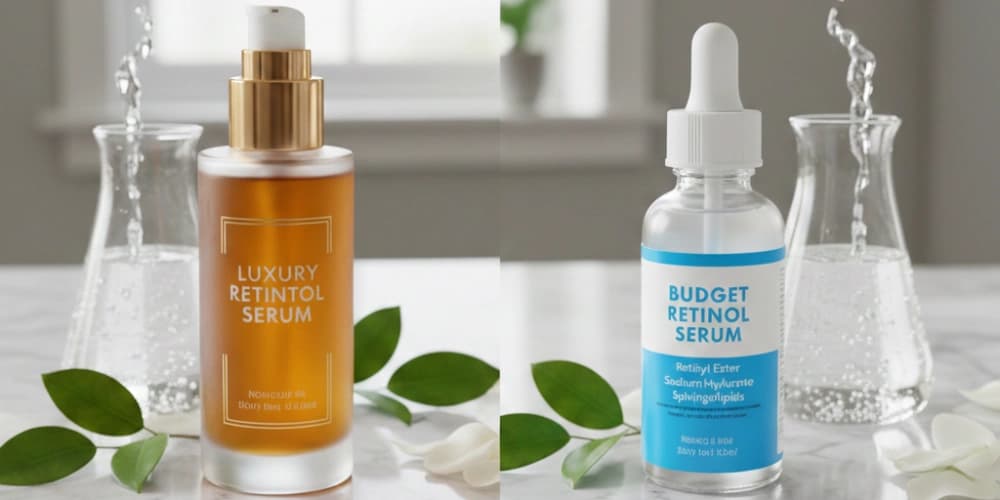
Retinol is the most researched anti-aging ingredient in dermatology. But premium retinol serums can cost $75–$95 a bottle, while alternatives with closely matching formulations sell for under $15.
We ran every retinol and retinoid product in the FindGlo database through our ingredient-matching engine, which compares full INCI lists position by position. These are the five strongest pairs it found — with the actual match scores, and honest notes where our evidence is thinner.
The 5 Pairs
| Premium product | Budget alternative | Match score |
|---|---|---|
| Murad Retinol Youth Renewal Serum (~$92) | The Inkey List Retinol Serum (~$12) | 86 |
| Drunk Elephant A-Passioni Retinol Cream ($74) | The Ordinary Retinol 0.5% in Squalane (~$8) | 82 |
| Paula's Choice 0.3% Retinol + 2% Bakuchiol ($36) | The Inkey List Retinol Serum (~$12) | 76 |
| RoC Retinol Correxion Deep Wrinkle Night Cream (~$27) | The Ordinary Retinol 1% in Squalane (~$9) | 74 |
| Medik8 Crystal Retinal 6 (~$79) | The Ordinary Retinol 0.5% in Squalane (~$8) | 70 |
Prices are list prices at the time of writing and change often — each product page on FindGlo shows live prices where we track them.
1. Murad Retinol Youth Renewal → The Inkey List Retinol Serum — match 86
The strongest retinol match in our database. Both build on a dual-retinoid approach — a conventional retinol alongside a gentler next-generation retinoid — in a lightweight serum base. Murad's tri-retinoid marketing is real chemistry, but The Inkey List's combination of slow-release retinol with Granactive Retinoid (Hydroxypinacolone Retinoate) covers the same ground for about an eighth of the price.
2. Drunk Elephant A-Passioni → The Ordinary Retinol 0.5% in Squalane — match 82
A-Passioni is 1% retinol in a cream with plant oils and peptides. The Ordinary is 0.5% retinol in plain squalane. That concentration difference is real — but for most people it's an advantage, not a compromise: dermatologists consistently recommend starting lower and building tolerance, and 1% retinol without encapsulation is a common irritation complaint. We wrote a full face-off on this pairing against The Inkey List as well.
3. Paula's Choice 0.3% Retinol + 2% Bakuchiol → The Inkey List Retinol Serum — match 76
Paula's Choice pairs a modest retinol dose with bakuchiol, a plant-derived ingredient with retinol-like effects and good tolerability data. The Inkey List's retinol + Granactive Retinoid combination is a different route to the same goal — effective retinoid action with the irritation dialed down — at a third of the price.
4. RoC Retinol Correxion → The Ordinary Retinol 1% in Squalane — match 74
RoC is one of the original drugstore retinol lines, and Correxion Deep Wrinkle Night Cream remains a solid conventional retinol in a moisturizing base. If you want the retinol without the cream — for instance to layer under your own moisturizer — The Ordinary's 1% in squalane delivers a higher concentration for around a third of the price.
5. Medik8 Crystal Retinal 6 → The Ordinary Retinol 0.5% in Squalane — match 70, with a caveat
This is the honest asterisk on the list. Crystal Retinal uses retinaldehyde, a different retinoid that converts to retinoic acid in one step instead of two — it genuinely works faster than retinol, and no sub-$10 product currently matches it like-for-like. The Ordinary's 0.5% retinol is the closest budget neighbour by ingredient profile, but this is a change in kind, not just concentration. If retinal's speed is why you're buying Medik8, there is no true dupe at this price yet.
How We Tested
Our methodology is straightforward:
- INCI analysis — Our engine compared the full ingredient lists of the retinol products in our database, weighting ingredients by their position (which tracks concentration).
- Match scoring — Every candidate pair received a 0–100 score based on shared actives, shared supporting ingredients, and penalties for meaningful differences.
- Evidence checks — Where our record of a product's ingredients is partial rather than a complete INCI list, the match page says so. Some of the pairs above carry that flag; the comparison view shows exactly which ingredients were compared.
What Makes a True Dupe?
At FindGlo, we define a dupe as a product that is chemically analogous — not just "similar vibes." The core retinoid has to match or closely correspond, and the supporting formulation has to serve the same function. We don't consider packaging, scent, or brand prestige. Only what the formula actually delivers to your skin.
What About Formulation Quality?
A fair question. Premium brands often claim superior "delivery systems" or "stabilization technology." In some cases this is legitimate — encapsulated retinol can be more stable and less irritating, and retinaldehyde (see the Medik8 caveat above) is genuinely a different molecule.
However, several budget brands now use the same stabilization approaches. Across the pairs above, our analysis found no consistent correlation between price and formulation sophistication beyond those specific, nameable differences.
Want to see how your current retinol stacks up? Use FindGlo's Compare tool to run a side-by-side ingredient analysis against any product in our database.
The Takeaway
You don't need to spend $90 on retinol. Based on ingredient composition and our pair-by-pair match scores, brand name alone is not a reliable proxy for value — but the differences that do exist (concentration, retinal vs. retinol) are nameable, and we've named them. Use ingredient analysis — not marketing — to make your purchasing decisions.
FindGlo exists to make this kind of analysis accessible to everyone. Because transparency isn't a luxury.