Understanding Skincare Ingredients: A Science-First Guide
Learn how to read INCI lists, identify active ingredients, and evaluate common skincare ingredient categories with a practical, research-informed framework.
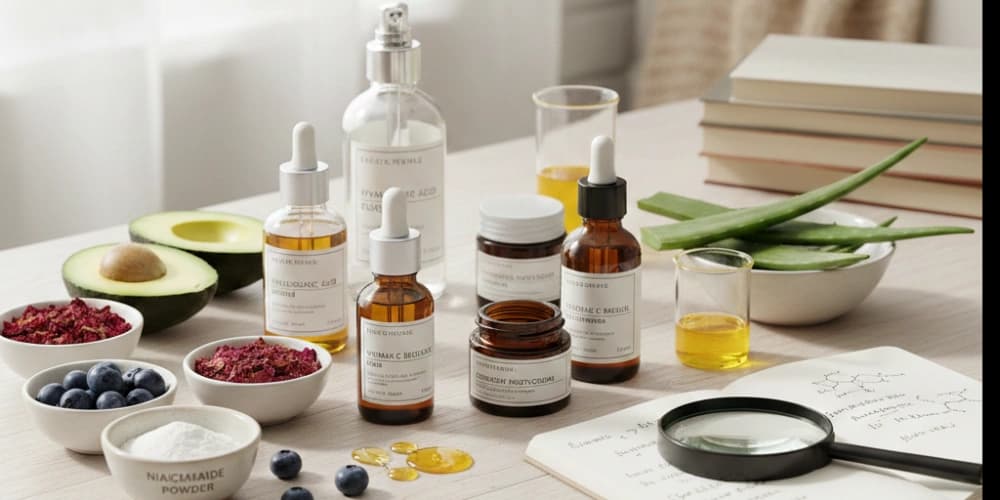
The skincare industry is worth over $180 billion, yet most consumers can't read the ingredient list on their moisturizer. At FindGlo, we believe transparency is the foundation of smart beauty shopping.
What Is an INCI List?
INCI stands for International Nomenclature Cosmetic Ingredient — a standardized naming system used worldwide. Every skincare product sold in the US and EU must list ingredients in INCI format, ordered by concentration (highest to lowest).
This ordering is your first clue to understanding a product's true value. If a product markets itself as a "Vitamin C Serum" but Ascorbic Acid appears near the bottom of the list, you're paying for marketing, not active ingredients.
The Active Ingredients That Actually Work
Published skincare research repeatedly highlights a handful of ingredient categories that are commonly studied and widely used:
- Retinoids (Vitamin A derivatives) — The gold standard for anti-aging. Look for Retinol, Retinal, or Tretinoin.
- L-Ascorbic Acid (Vitamin C) — Potent antioxidant at 10-20% concentration. Must be in low-pH formulations.
- Niacinamide (Vitamin B3) — Reduces pore appearance and strengthens the skin barrier. Effective at 2-5%.
- Hyaluronic Acid — A humectant that draws water to the skin. Look for multi-weight formulations.
- SPF Filters — Zinc Oxide and Titanium Dioxide (mineral) or Avobenzone and Tinosorb (chemical).
How FindGlo's Value Score Uses Ingredients
Our Value Score algorithm weighs Ingredient Quality at 40% of the total score. Here's what we analyze:
- Active concentration — We estimate the percentage of key actives based on INCI positioning.
- Formulation compatibility — Some ingredients cancel each other out (like Niacinamide and direct Vitamin C at low pH).
- Delivery system — Encapsulated or stabilized forms are rated higher than raw actives.
Common Ingredient Red Flags
Not all ingredients are harmful, but some are worth watching:
- Fragrance / Parfum — The #1 cause of contact dermatitis in skincare. Unnecessary in treatment products.
- Denatured Alcohol (Alcohol Denat.) — Can be drying and irritating, especially for sensitive skin.
- Essential Oils — Often marketed as "natural" but can cause photosensitivity and irritation.
FindGlo's skin type filtering automatically flags these ingredients based on your profile. Set up your skin profile to get personalized safety warnings.
How to Read a Label Like a Chemist
Next time you pick up a product, try this three-step approach:
- Check the first five ingredients — These make up the bulk of the formula. Water (Aqua) is almost always first.
- Find the actives — Look for the ingredients mentioned above. Note their position in the list.
- Spot the 1% line — Ingredients like preservatives (Phenoxyethanol) and fragrance typically appear at under 1%. Anything listed after these is present in trace amounts.
The Bottom Line
Understanding ingredients is the single most powerful tool in your skincare arsenal. It lets you find affordable products that genuinely work and avoid expensive ones that don't.
That's exactly why we built FindGlo — to make ingredient science accessible to everyone, and to prove that great skincare doesn't have to cost a fortune.